Friday, November 1, 2013

Halloween in Germany

Ach. My first Halloween in Germany. Etwas enttäuschend!

Last year, I was circling Great Britain around Halloween, because in Europe, you can zip off to foreign countries without spending very much money at all. I visited my "twin" Alan in Dublin, who was born on almost the same day as me, and then I headed south to England.

Halloween costume Norfolk-style

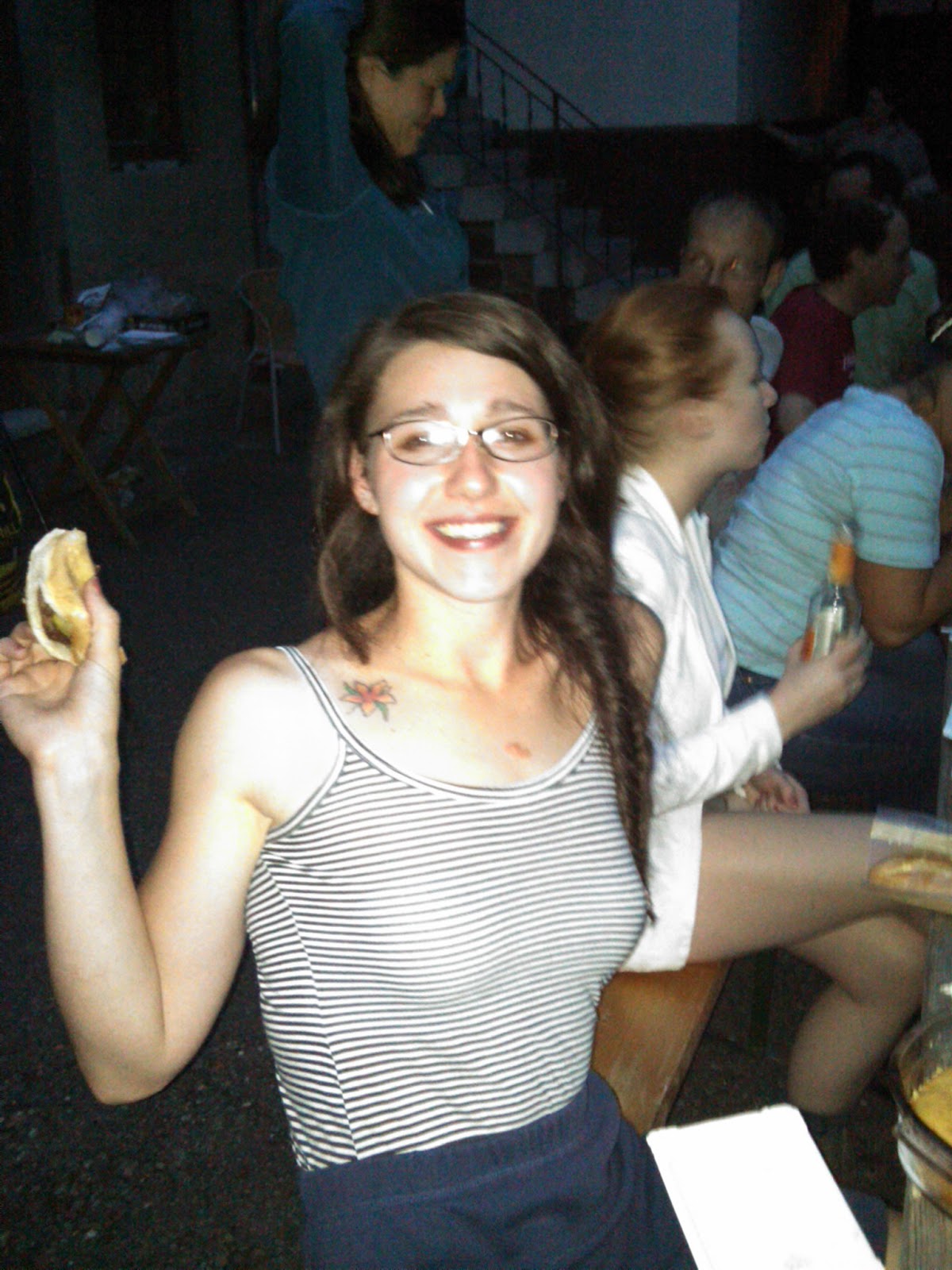
On Halloween Day 2012, I was in Norfolk, happily thrift shopping at King's Lynn charity stores with Joan -- an incredible woman and the sister of my entertaining friend Rob (photo above). Joan and I had a great day together. In addition to finding the best used clothing on the planet, we saw some little British trick-or-treaters, and stores were handing out candy. Though Halloween isn't celebrated in England quite like it is in the States, it didn't bother me that I missed it, because I wasn't at home. Anyway, retail therapy and a good cup of tea with Joan satisfied my every need. I even got my picture taken with a real bobby! 

And everyone spoke English. That's a plus.

Handsome bobby and me


Fast Forward: Heidelberger Halloween, late October 2013
This year, I would be in Germany on Halloween, and I would make the best of it. 

At school, we had a Halloween party on our last day before fall break. For some of the kids -- all of whom are at least half German or have grown up here -- it was their first Halloween celebration. They dressed up for our Halloween parade and party, and one little girl even came dressed in her witch costume a day early. Fellow teachers, classroom assistants, and one 10th grader helped decorate our lunchroom, making it frightening with the lights down low. We had kid-manufactured spiders and bats hanging from the ceiling, monster cookies, grape eyeballs, a floating hand in a pitcher of juice (thanks, Frau Bell!), bloody fingers (hot dogs and ketchup), rubber snakes and spiders, and other adornments. 

Just a small representation of the infinitesimal amount of Halloween frights at school

As chief American (the only American) and master of ceremonies, I let the kids in one at a time so they could soak up the ambience of the spooky stuff... and then we turned on the lights and blew out the candles. Kids wrapped their parents and classmates as mummies (with toilet paper), we played Hot Pumpkin (a version of Hot Potato), and we danced a little. Because it was the last day before a break, everyone over the age of 10 was pretty exhausted, except the kids of course, who played hide the IKEA rat 20 times before they grew tired of that game. 

Okay, so the buildup to Halloween wasn't so bad. There was active participation and it felt like Halloween, mostly. Our room decor topped any I've seen at any school ANYWHERE, and we even had a flying red-eyed bat. 

But you know that sometimes, with too much anticipation and great expectations, the letdown can be frightful.


HALLOWEEN - October 31, 2013, Viernheim, Germany

The day before Halloween, I bought three small, undernourished pumpkins (bad crop this year?), and we brought them home to carve. Surprising, the 4-pound pumpkins were easy to work with and cake to scoop out, for they had hardly any guts. After carving and lighting the two scary faces and a Halloween lights pumpkin, I felt our front walkway would be welcoming enough to little German varmints out on Halloween night. Or... we might not get any trick-or-treaters whatsoever! I had no experience with these matters, and Heinie, who told me we could wait to buy candy until Halloween, was no help at all. He knew NUTHINK. 


Alas, that was the entire problem. I had no help at all. 

Certain enough, the skies of Viernheim grew dark, and the howling and barking of dogs became rampant. Before I could complain twice that there weren't enough children filling the sidewalks of our neighborhood like they do back home at dusk, I saw little bandits dressed in dark clothing approaching! 

By this time, I had begun imbibing, because the resident ghoul at home was not talking to me (bad day at work and bad mood for the day), and I was far, far away from home on one of my favorite holidays. 

Perhaps the Germans don't understand. Obviously, Heinie hadn't a clue. Halloween is the spooky precursor to November: the month of my favorite Uncle Martin's birthday, Day of the Dead, the birthdays of many of my Scorpio friends, and then Thanksgiving!!!! Halloween a time that arachnids enjoy. Scorpions have a knack for scaring the crap out of people, and I am no exception. 

My drinking days behind me, I became quite intoxicated on one or two (or three?) Liquid Valiums (Crown Royal and Amaretto). Children were walking up the driveway and were about to ring. I had to frighten them, and being a drunk, middle-aged American woman in the middle of Germany was not enough! Thank goodness my Halloween CD was still in the player, and my sister had mailed a large bag of candy corn with my birthday shipment. I tore open the bag, filling a bowl, and I hit the play button on the stereo. 

Opening the door, I found 5 or 6 older children, mostly dressed in black. I couldn't tell what their costumes were, but mostly they had ghoulish masks. Perfect. I dug into the bowl of candy corn and adorned them and their bags with it, explaining what it was. I knew Germans were unfamiliar with candy corn. What I wouldn't have done for some individually-wrapped Gummi Bears, or even Snickers at that moment, but oh, well. One child said he didn't have a Tüte, and he opened up his hands to receive the candy. Not a one of them said "Trick or Treat," but it was a beautiful moment nonetheless.


Candy corn - difficult to find in Germany

After the kids left and I wished them "Happy Halloween," I stepped outside the door to listen for more. It sounded as if the streets of Viernheim were now overrun with little ghouls. I heard screams and loud gasps. I heard parents speaking in muffled German. I'd better get my scare ready once more. 

Children continued to visit our doorstep, and I counted about 20 or 30 kids. Not too shabby for a first Halloween overseas, but there were problems. 

The candy was not wrapped - a BIG no-no in America, because of all the razor blade and poison scares. I wonder if that razor blade thing was just a lie purported by the news media, backed by the candy manufacturers, so homemade popcorn balls and cookies would be banned from the Halloween bag? (That is a question calling for more research.)

I had no help. It would have been great to employ the services of the big ghoul with whom I reside. He has lots of scary knives, and he is tall enough to hold the red-eyed bat over the heads of the children. Or he could jump out from behind a corner and scare the living daylights out of young German children. Before Halloween came, he said he would help, but on the day of, there were barely words spoken. Das geht nicht. 

Next Halloween, we WILL have pre-wrapped, wahrscheinlich American candy for Halloween. And I'm either going to get some help scaring the children, or I'm fleeing the country. Shopping in England is a good option. 

Even better? Home for Halloween. It's not unheard of, is it? 

If I sound spoiled to you -- as if I should be satisfied with the German Halloween I had -- you're right. 

Halloween, since I was a little girl, was a favorite holiday. How else do you rake in a whole BAG of candy, all in one night?! No waiting for the Easter bunny. Trick-or-treating and other Halloween shenanigans were what we kids lived for every fall. 

As an adult, I began minor frightening from inside my front door after my son was old enough to trick-or-treat on his own and didn't want me around, dressing up in doom and playing scary music when the children rang. That progressed to setting up haunted houses in every place I lived in Colorado to a full-fledged haunted western town one year, with help from 20 of my best friends. Those were the days.

So yes, I'm spoiled. 

I know Viernheim isn't big on Halloween... yet. But we can change all that.

Happy November.


Dictionary
Das geht nicht. - That will not do.
etwas enttäuschend - somewhat disappointing
die Tüte - the bag (candy, paper, etc.)
wahrscheinlich - probably


Thursday, October 31, 2013

Living in Germany, Still

Boy, there's a lot of complaining back home. All the anger seems to be directed at one man: the U.S. President. It's his fault people can't feed their children; it's his fault they have to pay for medical insurance; it's his fault they have no job; because of him, they can't possess guns (even though that is not the case!); it's his fault that life sucks in general. Everything that is wrong with their lives is attributable to Barack Obama. When and why did the U.S. become a country with so much vitriol? Why do its citizens whine and complain so much? Why aren't things getting fixed? Why is there so much dissatisfaction, which spreads from person to person in epidemic proportions? Obama can be blamed for those problems, as well, I'm sure. It's all his fault. Poor guy -- he's just one man!


In Germany, there are also complaints about the government. There are complaints about everything, just like in the U.S. In fact, I find that certain Germans beschweren und schimpfen more than anyone I've ever met. However, now that I've been here for 18 full months, I can say that living in Germany is really pretty good, and I'd recommend it to anyone. Let me tell you about some benefits.

Vacation Days. In the U.S., the standard is 10 vacation days, or two weeks, per year. I'm a teacher, so I get more free days no matter what, but in Germany, people with "regular" full-time jobs get at least 30 paid vacation days, or six weeks. It's higher in certain other European countries and the longer you are at your job. My 26-year-old friend Alina is the manager of a drugstore -- a normal job, you might say. She just got back from a trip to the beach in Turkey; after that, she was able to travel to Luxembourg for an overnight stay. In the summer, she went to Croatia. It's really beneficial to mind, body and spirit to be able to take several two-week vacations per year. It helps deter burnout. 

Health Insurance/Tax Benefits. First of all, the system here works. Before I came over, I heard rumors that taxes were exorbitant, and I would be going to a socialist country (however terrible or true that is, I can't tell). Just over one-third of my pay, or 37%, goes to taxes and retirement. However, when I go to the doctor or dentist, visits are free, unless I need something extra (like a higher-quality filling than the insurance will pay for). Eye doctor visits are free as well. Medications only require a small copay of 5 or 10 euros. 

Further, sales tax on purchases, including food and clothing, etc. is included or non-existent. Therefore, I know exactly how much I am spending. There are no surprises at the cash register.

Other wonderful benefits come from my tax money, including the maintenance of and free admission into national landmarks, parks, castles and ruins, and very clean streets and efficient transportation and government. 

Over the summer, I was jobless, so I was encouraged to apply for unemployment, which is a given in Germany. I received enough to live on for three months, even though I was only working here for one year before I applied. 

Groceries are cheap! and food is fresher. In most case, it doesn't travel so far to get to stores, and there are what we would call "farmer's" markets almost every weekend in most towns. You can read on labels where your food comes from, and Ursprung: Deutschland means it was grown right here in-country.

A beautiful selection of pumpkins and gourds at the Weinheim Markt


When I first got to Germany, I was poorer than I am now. The economy in the U.S. was pretty terrible. My job there had pooped out, and I couldn't find anything else substantial (thus the move overseas for work). After selling almost everything of value, I still had to borrow money to get to Germany. Then I had to borrow money here for housing. I didn't get my first paycheck until almost two months after I started my first job. Therefore, I had to live on a budget of about 20 to 30 euros a week for food, after all my other expenses were paid.

However, that amount is plenty to buy coffee, milk for your coffee, toilet paper, good bread, and apples, which are mostly grown locally. Milk purportedly comes from the Alps (there are beautiful black and white cows on green pastures in the mountains on the cartons), bread from the bakery around the corner, apples from Süddeutschland, and the toilet paper comes from recycled products (see recycling below). You can go to the butcher and buy sausages and more sausages freshly ground that day and spend only a few euros. Leberwurst -- a mainstay in my diet -- ist cheap and delicious. Bakeries are even billiger. If you don't get food from Germany, it usually comes from sunny countries nearby such as France, Italy, and the Netherlands.

Beef is expensive, as well as corn tortillas, which are difficult to locate. If you want good Mexican food, it's costly if you cook it yourself with "imported" items from the grocery store, such as black beans and taco shells. But alas, I digress. Those are negative aspects about Germany.

Recycling. I always thought that if I went into politics, the first thing I would do is make recycling mandatory. It's so beneficial for the planet, and it creates lots of jobs. In Germany, we recycle paper, containers, food, and plastic bottles. You get 15 or 25 cents for each bottle you return, including glass beer bottles in many cases. There are paper, "Bio," and Restmüll bins out on the street, which are picked up regularly. Even your used paper towels can go into the paper bin, and your orange peels and other organic stuff go into the Bio container. At home, we have less real garbage than recyclable containers-- such as tin cans and milk cartons, and these go into "yellow sacks" and are placed out on the street about once every two weeks in big piles all over Germany. You need a lot of space in your kitchen or storeroom for all the items you recycle, but it's worth it. I feel ashamed when I am too lazy to walk my Apfel core out to the Bio bin, because in our house, we don't have a container for that. 

Banking. To handle bills in Germany, you use your bank account. You pay and get paid electronically. It saves a lot of paper and is very efficient. Since I've been here, I have also acquired a German credit card where my monthly payments are 10% of my total balance. That works for me. They just doubled my credit limit! I don't think I can get into too much trouble financially, because I just don't have the expenses I had back home. So far I don't have an automobile, because I can walk, ride a bike or take a train most anywhere I need to go, so that eliminates hundreds in payments, insurance, and gas. I would like a car, but right now, it doesn't make fiduciary sense. 

Ich vermisse mein Auto, aber...

Public Transportation. For reasons stated above, public transportation is very beneficial. Sure, it's like riding the bus; sometimes people stink, babies cry, and others talk too loud, but for economics and efficiency, it's great. Bring a book and an iPod, and you're all set. I can travel in a streetcar ("tram") to work and back home without much hassle at all -- the biggest worry is getting to my stop on time. If I want to go to Berlin or Hamburg, I can do that, too, on a bigger, faster train with comfier seats. I miss my car and my car stereo, but in Germany, it's hard to find a parking place sometimes, so you have to consider that. And walking can keep you fit, if you don't eat too many sausages and scrumptious Brötchen.

I'm sure there are more benefits to life in Germany, but for now, that's enough. It was a big adjustment living here at first, but now, I kinda like it. 

Come visit anytime!


Dictionary
der Apfel - (the) apple
beschweren - to complain
billig(er) - cheap(er)
die Brötchen - (the) rolls
ist - is
die Leberwurst - (the) liverwurst
der Restmüll - (the) garbage
schimpfen - to "bitch" or swear
Süddeutschland - southern Germany
Ursprung: Deutschland - origin: Germany


Saturday, October 12, 2013

How to Learn a Foreign Language

Because I am a teacher of and an avid learner of language(s), I may have a few tips for those who are trying to tackle a foreign tongue. These are simply my own recommendations, taken from personal experience and no yellow-bound coursebooks or language-learning websites.

First, listen AND look. Though we are all grown up now and think we know a lot, we have to really concentrate and open our ears when listening to a foreigner speak the language we want to learn. When we are children, our ears "detect" more sounds, because the language centers in our brains are more open and not yet fully versed in the phonemes of language. As adults -- especially adults who have known only one language their whole life -- it is oftentimes difficult to perceive or even hear different sounds in different languages. We cannot discriminate sounds we have not been exposed to before. Therefore, if you think you don't hear something correctly the first time, ask the speaker to repeat, and really watch their mouth move. Do what they do.

Speak! This is the most important, I believe, in language learning. You have to try out your new language, even if you're speaking the words incorrectly. Sure, there may be foreigners out there who are offended when you try to speak like they do, but I have encountered very few in my lifetime (and I consider myself almost old).

In American television and film, the French are portrayed as snubbing the foreigner -- especially us Americans. Perhaps the trick is to avoid France completely, but that is not the answer, because all French people are not bad, just like all American people or all German people -- all people anywhere -- are not bad. The snooty French women I have encountered in shops were either "aloof" (a nice term for rude) because they are snots no matter what, and not because I speak bad French (though I do, because I'm still learning and always will be). You will find such unhappy people everywhere.


For a laugh, check out the French waiter scene from "European Vacation":
http://www.youtube.com/watch?v=3iXGbJKjNxU

On a recent trip to Strasbourg (a beautiful Alsatian city very near the German border), I met several of these types, but on the whole, no one was rude to me because I spoke more English than French. They might have been unfriendly because I was with a German (longstanding animosity), but I don't think that was the case either. It didn't bother me. I attempted French anyway, because I try to ignore stereotypes, and how else to torment a brusque person than to needle them until they cave?

At one lovely little shop near the Strasbourg Cathedral, the handful of things I wanted to purchase were piling up at the cashier's desk. The beautiful and kind clerk/owner was very friendly and helpful, running upstairs to find me the scents I wanted when I asked. When it was time to pay, my credit card did not work, so I tried my debit card. It also did not work, for I had no money in my account (that can happen). Finally I gave her cash. The French woman didn't balk through the whole transaction, but rather smiled continuously and was very nice. She even gifted me a beautiful cloth bag with her shop's name on it. We spoke French to each other, and when I left the store, I felt not only proud, but as if I had made a lifelong friend. Hers will be the first store I visit for gifts or souvenirs the next time I am in town. And I will make sure I put more money into my account ahead of time.


Most people are helpful and are happy to give you pointers when you make a mistake in their language. Don't be intimidated. Try out your new language out as much as you can, even if you don't need to use it. When you make an effort, the people to whom you are talking shoould appreciate that at least you try to speak their language. They might start talking to you so rapidly they think you already know a lot more, and that is a compliment. Good job! You gave the impression you know what you're doing. If that happens and someone is speaking to you too quickly, know the word for "slow" or "slower" in their language, so you can ask them to slow down a bit. In German, you can say, Wie bitte?, which politely means "what?"

Play. When you are relaxed, you learn more. Try learning language with a foreign friend by playing games with them, drinking a beer or glass of wine, or simply making friendly conversation. Don't worry so much about the content or quality of your language output. Your counterpart will speak many words that you will learn while in your comfort zone, and during this time, language seems to penetrate the brain better. When you are tense and worried -- even about whether you're speaking correctly or don't know a word -- the language absorption rate won't be as high.

For example, when I was 16 years old, my good friend Jill and I began our high school beer-drinking education with Adrian (R.I.P.) and Modesto, two fun Mexican busboys who worked at Los Compadres Mexican Food where I had my first job. Jill's stepfather was Mexican, so she already had a foundation in Spanish, but I had only learned my ABC's and a few other words in first grade. For some reason, I always remembered the word zanahoria ("carrot"), but that was about it. However, because we were having so much fun with Adrian and Modesto, it didn't take long before I was thinking in Spanish and churning out Mexican colloquialisms just like un hombre del campo. Adrian became my lifelong friend, and he taught me more Spanish than I could learn anywhere else, even in a college language course. One of my fondest memories is of playing the game Catch Phrase in a hotel room in Rocky Point with my sister Karen, Adrian, and several other English and Spanish speakers. Adrian and I were able to get most words right, because I could give him hints in Spanish -- then he could give the right answer in English. Being bilingual pays off more often than you think!


Adrian (right) taught us gringos lots of Spanish. We miss you, Ese!

It has been proven that having fun while learning works. Many tried and true language-teaching techniques involve the use of games in the classroom. Playing, relaxing and having fun while learning a foreign language help you gain many new words.

Social language is probably the most important aspect of initial language intake. And don't forget pillow talk, if your language learning takes place with a lover. You will at least learn the names of body parts, and perhaps the most important word: love.

Use a dictionary. When I don't know a word, I look it up. Then I try to make sense of that word, especially if it bears no resemblance or relation to anything I know in any other language. Make sure your dictionary is as fat as you can carry. Mini-dictionaries are good for travel, but they won't have all the words you need to learn. Google Translate is also a great tool for finding words.

A good friend and fellow ESL teacher told me once that most people need to see or hear a word 12 times before it is committed to memory. Write the word down somewhere and review it when you can. Try to use it in a sentence.

For me, seeing the word in written form is very important, because I am a visual learner. This also helps a person learn how to spell it correctly, and see its individual parts, so you might find commonalities with other words in the same language. For example, in the word die Wahrheit ("truth" in German), the -heit means "-ness" in English. Therefore, I know that any word ending in -heit in German will be a state of something. I can also assume that any German word ending in -heit will be feminine, with the article die. Another example is the German word/suffix Zeit meaning time; a word ending in -zeit will be some kind of event or type of time, i.e. Mahlzeit (mealtime).

With today's smartphones, you can access apps for translators in many languages. Use them if you can, but more importantly, use them and try to remember the words. Sometimes there is nothing more frustrating to a foreigner or language teacher than a pupil who needs to be told simple words over and over again. Try to commit foreign words to memory.

When learning language, use everything and anything that works for you. There are many free websites out there for children and adults. Livemocha.com teams you up with language partners and gives you written and oral exercises in many languages, and you can make friends overseas as well. BYKI.com ("Before You Know It") has virtual flashcards and different tests that make learning simple and straightforward. Buy magazines or watch television in the target language. 

Again, don't forget to speak the language you are learning. You'll cross cultural barriers and show the world you care.


Dictionary
die Liebe - the love
die Mahlzeit - mealtime
die Wahrheit - truth
die Zeit - time

Thursday, September 26, 2013

Der Zahnarzt (the Dentist)

Today I had my second visit in seven days to the German dentist, or Zahnarzt. In my case, I went to the Zahnärztin, because my dentist is a woman. She's very nice, and she speaks a lot of English. If you need a good dentist in Germany, I'd recommend this one. 


It's funny, but Dr. Knobloch is the second medical provider out of three I've had in my short time in Germany who is named after food. Her name probably comes from the word for garlic, which is Knoblauch. Heinie's Mutter, who ventured with me both times to the dentist -- because Dr. Knobloch is her dentist as well -- agreed that garlic could be the source of the name. 

In my not-so-vast experience with German dentistry, I'd say it's pretty much like American dentists I've gone to. The waiting room and back offices are clean, and the same tools loom in front of your face while you wait to get your teeth cleaned. The only thing missing in this dentist's office were the Highlights magazines we read as kids, turning to the hidden pictures page first thing, and framed artwork adorning every wall. Also, Mutter Heinie and I had to buzz to get in the door, because the dentist works on the bottom floor of a house, or small apartment building. It also didn't smell like any dentist's offices I'd been in. It didn't smell at all. 

Sitting in the chair today for my filling -- the first I have had in over 30 years -- I relaxed. I was tired and could almost sleep. I wasn't scared. I knew it would suck no matter what, and why make it worse with worry? Besides, Germans are so efficient that I figured my treatment would be quick, easy and painless. I trusted Dr. Knobloch, because she seemed quite proficient during our first meeting, and she was pleasant. 

The dental assistant Anna turned on the radio to distract and entertain both of us while she filled my syringe with numbing agent. Anna didn't know the name of the medicine that went inside the syringe; I offered up Novocaine, but she hadn't heard of that. A song on the radio began after some German chatter, reminding me of Tom Cruise and fast jets, for it was the theme song from "Top Gun." Kenny was singing about a highway to the danger zone, and going right into the danger zone. Not the best song for sitting in a dentist's chair. 


"Maverick" flashing his pearly whites. He also has a great dentist.
My filling took quite a long time, because after all, it has been 30 years at least, and I had a cavity under the original filling. The doctor had to drill and dig and bore around my old filling, remove it, grind and bore more tooth away, and place a new filling. At her direction, I felt the hole with my tongue when she was done excavating, and it was sizable -- almost the entire expanse of the whole tooth. One of the drills she used sounded like a Motorad inside my mouth -- it was that strong and powerful. She called that one the Bohrer, which means "drill." The small drills then must have other names, like "spinning painful needle," however that is in German. 

One aviso if you go to the dentist in Germany: don't get the amalgam filling. It's supposedly harmful to your body, though it's the only type the German Versicherung will completely pay for. Order the Kunststoff fillings. They're better, ceramic, and harden with a cool blue light. 


Another warning: don't panic when the dentist comes at you with a syringe and says, "Vee haff to giff you zee injektion now." Thought it may call up memories of Dr. Szell (Laurence Olivier) in "Marathon Man" (see clip below) or Sergeant Schulz in "Hogan's Heroes," it's just how they talk. Don't let scary, old Nazi movies frighten you out of going to the dentist. Just try to relax, drift off, and let the Novocaine or whatever it is in Germany do its work.

Is it safe?

http://www.youtube.com/watch?v=c-OviftusB8


Wednesday, September 25, 2013

Mark Twain and the German Worker

My breaktime view of the Neckar
Lately I have been very busy with my new job in Heidelberg at a brand new primary school. Not only do I love my new workplace, but the blessings, honor and wonderful scenery are all mine when I "de-tram" at Brückenstrasse ("Bridge Street") and walk across the large bridge toward school, with views up and down the Neckar River. To my left is the castle and Altstadt, and on the right, the river winds down valley to Mannheim and beyond. I could disembark at Bismarckplatz, the busy bus and streetcar station that is much closer, but I like walking my way -- the "back" way -- better.


Heidelberg's busy Bismarckplatz

My ride to Heidelberg from Viernheim is almost an hour long, but it offers me the chance to read. Last week I began A Tramp Abroad by Mark Twain. It is delightful, and I laugh out loud reading him. He can put into words a perfect combination of sarcasm and irony, without being too insulting, and he has a unique way of analyzing the working German people of his time.

"Let this be a warning to the reader. The Germans are very conscientious, and this trait makes them very particular. Therefore if you tell a German you want a thing done immediately, he takes you at your word; he thinks you mean what you say; so he does that thing immediately -- according to his idea of immediately -- which is about a week; that is, it is a week if it refers to the building of a garment, or it is an hour and a half if it refers to the cooking of a trout. Very well; if you tell a German to send your trunk to you by "slow freight," he takes you at your word; he sends it by "slow freight," and you cannot imagine how long you will go on enlarging your admiration of the expressiveness of that phrase in the German tongue, before you get that trunk. The hair on my trunk was soft and thick and youthful, when I got it ready for shipment in Hamburg; it was baldheaded when it reached Heidelberg. However, it was still sound, that was a comfort, it was not battered in the least; the baggagemen seemed to be conscientiously careful, in Germany, of the baggage intrusted to their hands." (Chapter XX)

My experience with German Arbeiter is somewhat the same, even in these modern times. Germans have administrative processes. Unlike America, where everything is rush-rush, go-go-go, and overnighted due to extreme urgency, Germans take their time. Nothing should be rushed, because it must be done correctly. Why produce something prematurely, such as a driver's license that was promised within four weeks, before the four weeks have run out? One would not expect to receive it sooner, because one was told four weeks. Why would my Jobticket (discounted monthly tram ticket) which was submitted to the transportation authority on August 28 -- two weeks before I started work -- definitely not be mine until October 1st, though we live in the electronic age, the money has been removed from my account, the paperwork is in the right hands, and I need the ticket every day I go to work?

This is Germany. There is a required waiting time, and not because the people do not care to work. It seems to be simply a matter of prioritizing, and/or making people wait because that is what is expected.

Heinie has a garage door and metal-building business. Several of my new and good friends in Germany (one German and two Italian) have consulted him with regard to various metal needs around their homes: a kitchen stove ventilation hood, a copper pipe that will direct water away from a house on very rainy days, and several different awnings and garage doors. Because they like and trust me, they like and trust him, I think. However, there is no immediate rush to get the work done for these friends. There is some kind of required German waiting time that they should already know about. It is hard for me to comprehend or explain to these people, who have water pouring into their basements on rainy weeks and the haze of smoke from frying Schnitzel attaching itself to their kitchen ceilings. Heinie cannot be bothered, though I make gentle suggestions at least twice a week for him not to forget about my friends' problems. He always has much bigger jobs to accomplish first -- jobs that have materialized from thin air; jobs that were ordered months before.

Couldn't a person finish a small job immediately in order to tackle a larger, newer job later? Wouldn't there be less stress if you finished the small things and made your friends happy, so they can tell their friends? I do not know, I am not a German businessman. However, in my world, annoying tasks can be handled quickly and thus less painfully. And I am a procrastinator.

In the southwestern United States, there is the opinion and longstanding stereotype that Mexicans are lazy and take naps in the middle of the day, under a saguaro cactus, if one is nearby. In my many years experience working with mexicanos at the restaurant and in other occupations, I found that they are on the job earlier, paid less, and work longer hours, at crappier jobs. They are very hardworking people, for the most part. Though they cannot be rushed, Germans are hardworking, too. Or perhaps it is just the women that seem a bit more diligent.


Twain wrote about that, too, telling how male bystanders on the river stepped aboard their raft often, but the women did not have time.

"Only the men did this; the women were too busy. The women do all kinds of work on the continent. They dig, they hoe, they reap, they sow, they bear monstrous burdens on their backs, they shove similar ones long distances on wheelbarrows, they drag the cart when there is no dog or lean cow to drag it, -- and when there is, they assist the dog or cow. Age is not matter, -- the older the woman, the stronger she is, apparently. On the farm a woman's duties are not defined, -- she does a little of everything; but in the towns it is different, there she only does certain things, the men do the rest. For instance, a hotel chambermaid has nothing to do but make beds and fires in fifty or sixty rooms, bring towels and candles, and fetch several tons of water up several flights of stairs, a hundred pounds at a time, in prodigious metal pitchers. She does not have to work more than eighteen or twenty hours a day, and she can always get down on her knees and scrub the floors of halls and closets when she is tired and needs a rest" (Chapter XV).

My best German friend Dana started a new job in April, working 10 to 12 hours a day, and often on Saturdays. She mostly sleeps on Sunday, so you should not attempt to rouse her, and I don't. She won't answer. She takes the Day of Rest quite seriously. But poor Dana hardly gets to see her boyfriend, and she still has to keep a clean house and manage all the other duties living requires, such as grocery shopping, meeting up with friends, tending to her family, etc. Is it worth it? Well, she bought ice cream the last time we were together, so her job is paying off in more ways than one, but I don't understand how she does it. Perhaps one of her best friends today is Mr. Coffee.

Am I spoiled? Do I get paid enough to work 12 hours a day for weeks at a time? No. Perhaps occasionally I must, and it is worth it for one of my employers (who pays hourly). Otherwise, life is too short and I cannot be counted on to be so diligent and fleissig like many Germans are. I try not to worry that much. Thank goodness my great new job gives me this flexible schedule so I can stay home some mornings, sit at the computer, and write (like Mark Twain) about how hard the Germans work. 


Wörterbuch
Arbeiter - worker(s)
Brücke - bridge
fleißig - industrious, hardworking
Straße - street

Note: The German language has a double "s", or ess-tset: ß. Do not mistake it for a B. It is simply two S's put together into one letter, for efficiency. 


If you need more evidence about hardworking Germans, there is an old children's song to teach the young ones about hard work and who must do it:

Refrain:
Wer will fleißige Handwerker seh'n?
Ei, der muss zu uns hergeh'n!

1. Stein auf Stein, Stein auf Stein,
das Häuschen wird bald fertig sein.

Refrain

2. O wie fein, o wie fein,
der Glaser setzt die Scheiben ein.

Refrain

3. Tauchet ein, tauchet ein,
der Maler streicht die Wände ein.

Refrain

4. Zisch, zisch, zisch; zisch, zisch, zisch;
der Schreiner hobelt glatt den Tisch.

Refrain

5. Poch, poch, poch; poch, poch, poch;
der Schuster schustert zu das Loch.

Refrain

6. Stich, stich, stich; stich, stich, stich;
der Schneider näht ein Kleid für mich.

Refrain

7. Tripp, trapp, drein, tripp, trapp, drein,
jetzt geh'n wir von der Arbeit heim.

Refrain

8. Hopp, hopp, hopp; hopp, hopp, hopp;
jetzt tanzen alle im Galopp. 


http://www.youtube.com/watch?v=i63doTso8FY


Sunday, September 8, 2013

Der Arzt (the Doctor), Part I

Recently while jogging in the park, I took a spill and earned myself a nasty scrape on the front of my right calf. My hand was also cut. There were small rocks and other unsightly things embedded into my skin. It was plain ugly.

Due to my emotional state at the time and the pain that I had imposed upon my person while fighting to stay in the best shape I can -- despite all the good German bread, chocolate, and pork sausage I consume -- I cried all the way home. Sadly, no Germans that passed me on the street stopped to help or ask the reason for my suffering. Ein Polizist drove by, and I hoped that perhaps he, as a protector of the community, might be curious about my pain and tears, and maybe even drive me the rest of the way home. 

Boy, wouldn't that make for a good story?! But did he stop? Nah. 

I cried even harder. 

Yes, I am melodramatic sometimes, but I wanted some tender, loving care!

At home, the response was only slightly better than that given me by the other Germans I had encountered so far that day, so I treated my own injuries. Having smuggled two bottles of hydrogen peroxide from the States (in Germany, Wasserstoff Peroxide is expensive and only available in pharmacies), I poured some of the precious liquid over my dirty hand and leg, watching the wounds bubble and foam. Having worked in a doctor's office, I learned that hydrogen peroxide can be used to to clean, dissolve blood spatters and stains, and perform other minor miracles.

Five days later, the wounds were healing well, but I began having another problem. The skin below my ankle was becoming warm and painful, as if there was an infection under the skin. It was obvious I should go to the doctor.

On a Sunday morning after a good cup of coffee, I was transported to the Krankenhaus in Viernheim, which is more like a walk-in clinic. There were no loud ambulances pulling in; there were no uniformed men in green pushing stretchers; there were no white-robed nurses or doctors rushing from room to room, stethoscopes around their necks. In fact, no one else in the whole town of Viernheim was having any kind of medical emergency -- at least not there -- because I was the only one waiting in the sanitary corridors. After I walked in, a Frau behind the glass at the entrance signaled to another Frau behind closed doors. The second Frau came out and took my insurance card, asking who my Hausarzt was. Because I didn't understand what that meant, I deferred to my German translator/driver to answer. 

One great thing about Germany is that with your health insurance card, you pay nothing. Previously, there was a 10-euro copay, but that requirement has been eradicated in recent months. When you hand over your insurance card, the German computers automatically know where you live, and a small form prints out for the doctors to write on.

While we waited in the corridor, Sunday morning mass was going on in the Catholic hospital chapel. The pipe or electronic organ must have been right by the door where we sat, because I could hear it clearly. I meant to go look at it, having been raised by a family of church organists, but I was so filled with wonder after my doctor visit, I forgot. 


Within short minutes, we were ushered into the office of the doctor on duty -- Dr. Wurst ("sausage"). He was the only one there. No one took my blood pressure or weighed me. My body temperature was not a concern either. There was no examining table, no medical assistant, no nurse -- nichts. I sat down in a chair by his desk and held up my leg with my hands. Dr. Wurst, who also spoke some English, looked at my wound, made the proper recommendations, treated it with some cold liquid squirted onto a bandage, and wrote out an antibiotic prescription to take to the nearest open pharmacy. We would have to drive several kilometers, because on Sundays in Germany, most businesses are closed. 

The doctor was an intelligent man (as most doctors are). In answer to my questions regarding emergency health care in Germany, he gave interesting responses. 

He told me that in most of Europe there are emergency doctors that travel to the scenes of accidents, fires, etc. In Germany, such a doctor is called a Notarzt. That doctor has everything he needs to stabilize a patient at the scene of the accident.  Notärzte are just as prevalent as firemen and EMTs, and they drive orange and white emergency vehicles with sirens and flashing lights. These types of doctors sit and wait just to be called out, like paramedics in the USA, and handle  between 5 to 15 accidents/calls per shift. 


In America, there are oftentimes greater distances between injury victims and the hospital. Dr. Wurst told me that paramedics and EMTs are trained to prep patients for travel, and get them on the road to the hospital as soon as possible. In Europe, the emergency doctors treat victims at the scene until they are stable enough to travel, because there are hospitals closeby. 

Therefore, emergency room doctors do not exist, as a specialty, at least not in the smaller hospitals such as the one in Viernheim. The doctor that saw me was the only one in the hospital, a doctor from a practice of 15 that work in Viernheim and Lampertheim (a neighboring city). He said that in a city of 30,000 or less people, one doctor is always on duty in a hospital, so a city with more than 30,000 will have two doctors available, and so on. 


I got an education from Dr. Wurst, and he sent me on my way, telling me to visit my Hausarzt the next day for follow-up. 


Dictionary
Frau - woman
Hausarzt  - family physician
Krankenhaus - hospital
nichts - nothing
Notarzt - emergency physician (plural - Notärzte)
Polizist - policeman
Wasserstoff Peroxide  - hydrogen peroxide
Wurst  - sausage


Sunday, July 28, 2013

The Grillparty

Ah, the Grillparty. Now that it is endlich Sommer in Deutschland, Grillpartys abound. (The correct German plural form is Grillpartys.) 

Grillparty means "barbecue" in Germany. At a Grillparty, eating is the main event. 

Yes, I know, barbecues always entail eating grilled food outdoors, but a German Grillparty is different. Usually one or two men (or women) -- the Grillmeister(s) -- do the grilling, while the rest of the attendees sit at tables of various lengths, waiting for the food, talking. 

The Table is the true hub and focus of the Grillparty, because it is where the people gather and stay. It is adorned with dozens of salads, condiments, and various types of bread upon which the meat will be lain. 

On the table there will likely be alcohol, i.e. wine, beer, perhaps some Schnapps, and other types of beverages present, including carbonated water, cola, and Apfelsaft. Unlike an American barbecue, you won't find many ice chests chock full of soda cans and bottles of beer dotted around the table or sitting next to the house. Drinks are served either fresh from the fridge or at room/outside temperature. Ice is a precious commodity in Germany, or non-existent, even on 104-degree days.

After the grilled items are properly seared and browned, guests may get up (this is one of very few opportunities to move) to take their plates and obtain their choice of cooked meats. Then they return to the table, where they again sit, eat, and talk. Or a plate of meats is passed around the table, along with the other foods, condiments, and drinks.

Following the meal there is more sitting and talking, and perhaps some heavier drinking or more apple juice intake. And this goes on into the dark. Sitting. Eating. Talking. Eating. Drinking. Sitting.


My first Grillparty... they sit, they eat, they talk, they eat, they sit.
The first official Grillparty I ever attended was last fall, when my co-worker Bernard invited everyone to Weinheim for his apartment-warming, or Einweihungsparty. The invitations were handed out personally by him. On the opening page, the invite announced, "Bring your own sausages." 

Was this for real? I could only laugh. Okay, an invitation might say BYOB or bring a side dish, but never had I been told to supply sausages. I laughed again.

When a friend and I arrived late to Bernard's Grillparty, most of the food had been eaten, and the guests were sitting civilly around a very long table. We felt like we were interrupting their peace and quiet. Was this a barbecue or not? No one was milling about, laughing, waving their hands while explaining a fish story. 

Where were the raucous children? Where were the obnoxious drunkards? Where was the very tipsy in-law? Ach, this just wouldn't do.

Though there must have been room for 30, we still had trouble finding a seat. Bernard's friend Bernhard (the other B) was still grilling the remaining few shishkabobs of Cevapcici -- the dregs of the barbecue. Obviously all the sausages were gone, and all I brought was a big bottle of ketchup (per Bernard's instructions) and a bottle of wine, so I took it we as latecomers wouldn't be eating much that evening.


Midwestern-American girl Jamie stirs up fun at a Grillparty
Yes, at a Grillparty, the challenge seems to be how much you can eat and how long you can sit. There is no poolside splashing, no badminton, no ping-pong. Oh, yes, there IS beer drinking, and drinking of all kinds, but there is very little, if any, movement, except from the hand to the mouth and the working of the jaws for chatter.

Yawn. Snore. Bloat.

I love my German friends and my new German family, but we truly need to move, especially after taking in two pounds of pork in various forms: sausage, Steaks (pronounced "shtakes" -- and these are not made of beef, mind you), Spareribs ("sh-pare-ribs), and Wurst (sausage again, but there's always so much!). Couldn't we stand up and talk? Couldn't we go into the kitchen to make cocktails? Couldn't we play a quick game of horseshoes? 


Typical Germany Grillparty fare (for 4 people!)

On Friday night, our neighbors had a Grillparty to celebrate their move back home to East Germany. After the moving vans were completely filled, the Grillparty began. I made my salsa and guacamole, because I am, after all, half Mexican. (Well, not really, but I tell people that, and Germans are extra gullible since we have such a language disparity.) The condiments began to appear on the three long tables, crowded together on the neighbor's terrace to accommodate 11 Germans and one American.


How many condiments can you place on YOUR Grillparty table?


I wasn't sure if I should enter the Grillparty realm: it was claustrophobic on that terrace, and there were Germans everywhere. My language skills are minimal. I eventually took an outer chair by the stairs for quick escape if need be and waited while the future ex-neighbor's father grilled at least 40 sausages of 2 kinds. 

The guacamole, chips and salsa were on the table, and the German men were properly tormented by the scharf bite of the chilies, so I could now relax and observe. My job was done. 

On came the platters of sausages, overfilled. I forked one, still sizzling, and searched the vast array of mustards for a suitable brand. Ah -- the Currysenf. I hadn't tried that yet. They have curry ketchup, but I knew nothing about curry mustard. It was delicious.

Shortly thereafter came another platter of sausages, when I had almost finished my first. Should I have another whole sausage? No, I would split one with Heinie. After all, there was more mustard to be eaten. 

The second sausage was different and delectable -- it had a casing that turned crispy and brown on the grill, and separated from the inner sanctum of the Wurst, almost like a flour tortilla wrapping. It was a special sausage -- Kastenwürstchen -- brought all the way to Viernheim by the mother of the moving. It was delicious! 

Here's a bit of grammar for you: "-chen" added to any noun in German makes it diminutive, or smaller. A Hund is a dog, but a Hündchen is a puppy. Eine Blume is a flower, but a Blümchen is a little flower. 

These new sausages were named Kastenwürstchen, but they weren't small by any means. They were just as large as the other full-size, 8-inch and thick sausages.

Ach, now I was full. But there were so many condiments that had to be slathered! And platefuls of sausage to be eaten! When my stomach cleared some, I ate one more of the special East German sausages. Now I was really full.

But no... though it was meant to be avoided, 30 pork shteaks had been grilled by the incognizant Grillmeister, and he soon put them on plates and was delivering them to the tables. I couldn't eat anymore, but dang did that shteak look good. And besides, there was Kräuterbutter on the table. I can't believe I fit it in, but I ate the pork steak, too. Thank goodness it wasn't too large. 

After we ate, we sat, as good German Grillpartygoers should. But after a few minutes, I couldn't any longer. I used any excuse I could to get up, such as picking up plates, capping bottle after jar of condiments, taking dirty silverware to the kitchen, making a cocktail. I had to move, or I would turn into one big side of bacon. 


Shots of Schnapps or other liquors... they come out at the end of a Grillparty
Full of pork and stifled by immobility, I had trouble sleeping that night. I was full all night and into the next day. The only cure was the fiber of some good Müsli, an Apfel, and lots of water. But alas, we would be grilling again the next night, and I was sure there would be too much food. And lots of sitting. 


Grillparty: Sitting. 

When asked why Germans mostly sit at a Grillparty, Heinie said, "Schatz, this is Europe." There was no further explanation. 

Needless to say, I've since researched the purchase price of a set of horseshoes in Germany, though the Germans I know tell me they throw horses and not their Hufeisen. They think this is a very funny joke. 

No matter: I'm going to try to get these people moving, or at least reduce the size of my own Speck following a Grillparty. 


Dictionary
Apfelsaft  - apple juice
Einweihungsparty  - housewarming (party)
endlich Sommer in Deutschland  - finally summer in Germany
Grillparty  - barbecue
Grillmeister  - master of the barbecue
Hufeisen - horseshoes
Kräuterbutter - herb butter
Schatz - Dear (lit. "treasure")
Spareribs - spare ribs
Steak - steak, often of pork (pronounced "shteak")
Speck - bacon
Wurst - sausage

Sunday, June 9, 2013

Das Wetter (the Weather)

Two all-encompassing words to describe German weather? Predictably unpredictable. But I can think of more: rainy, cloudy, gray, cold, wet, and then sunny, if you're lucky.

A beautiful yet partially bedeckt dawning sky over Hesse


Not so fortunately, I found myself trapped in Germany for the "darkest" winter in 40, 50, perhaps even 70 years, though one person said 100 years. It is not necessary to check data as to how long it has been since Germany suffered through sunless skies day after day, week after week, month after month, because there is no changing the facts. It was cold, gray and miserable for a long time. 

Over the dark winter of 2012-13, it was chilly, but not so cold you couldn't play outside. There were even one or two days where it was nice enough outside to open your doors to the world, even in February and March. Sleeping with the window open during the winter didn't turn me into an ice cube, either. If one has the proper sleeping gear, such as flannel pants, socks, a warm long-sleeved shirt, a triplet of blankets, and a down-filled duvet, they can survive the harsh and wet cold outside. I choose also to include two feather-filled pillows and two smaller pillows, plus a large stuffed animal to hide in my bed (cave) with me.

Spring was barely present this year, and summer has taken a long time to get here. March was pretty rough -- it came in like a lion, and that fierce cat stayed through the end of May. It was cold, cloudy and/or rainy every day. 

Though temperatures got up to what most would consider hot only just this week -- Endlich Sommer! they said on the German news -- yesterday and today it rained again. And the long sleeves are back. Walking to the bakery around the corner this morning in jeans, boots and a rain coat, I carried a sturdy umbrella (Regenschirm) overhead. No matter the gear, by the time I got home, much of my clothing was soaked. Oh, believe me, I was smart enough to pack a plastic bag in which to transport the Kurbiskernebrötchen I love so much.

Mark Twain was credited with saying, "Everybody talks about the weather, but nobody does anything about it." When it rains day after day, what do you do? Germans say Scheisse Wetter, then they pull out their umbrellas and raincoats. Hey, it has to be worse in the U.K., coined "die Regeninsel" by people here on the European mainland.

Germans have a good word for overcast skies: bedeckt. Covered. Cloudy. It is often bedeckt here, so when the sun comes out, it is time for celebration. Get on your bicycle and go. Sit outside on your terrace. Have a Grillparty. Point to the small patch of blue sky and make note of it, because it may not be there for very long. (But you can always have hope.)

It stopped raining for a few hours. Get on your bike and ride!


Dictionary
bedeckt - cloudy, covered
endlich Sommer - finally summer
Grillparty - barbecue
Kurbiskernebrötchen - pumpkin seed rolls
die Regeninsel - rainy island, island of rain
der Regenschirm - umbrella
Scheisse Wetter - shit weather